
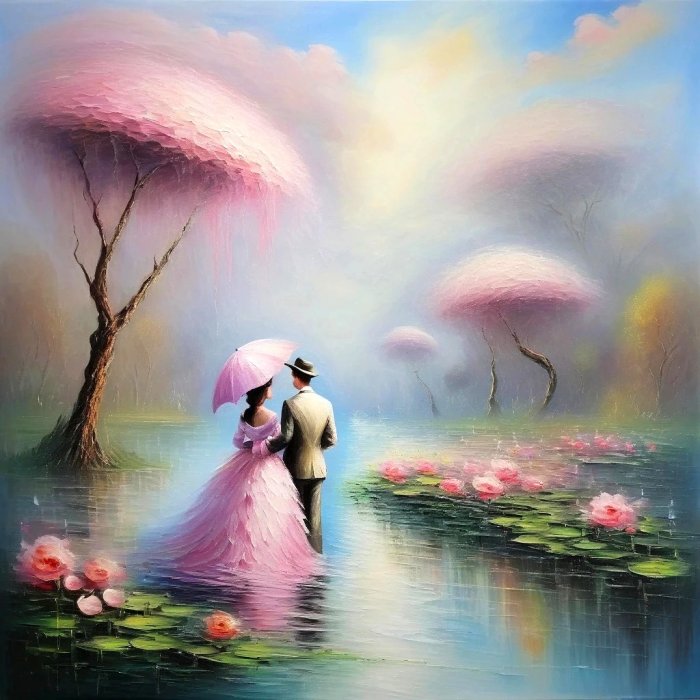
 Art has always been a language that allows us to express what cannot be conveyed through words. Symbols and metaphors have become key tools for artists who seek to tell a story, evoke emotions, or communicate ideas through their works. They enable the viewer not only to see the image but to feel its meaning, to immerse themselves in the hidden story of the painting, and to discover new horizons of perception.
Symbolism in art is a way of conveying ideas through images that carry cultural, historical, or personal connotations. Such connotations are often predefined. For example, a dove frequently symbolizes peace, a red rose represents love or passion, and a clock signifies the fleeting nature of time. On the other hand, a metaphor is a more complex conceptual approach. It creates associations between two distinct phenomena, allowing the viewer to perceive the connection between them. For example, a tree with exposed roots can serve as a metaphor for the human soul or the story of a life (or it may not). This connection between phenomena doesn’t have a fixed connotation like symbols, making metaphorical interpretations much broader and more individual.
For an artist, the use of symbols and metaphors offers a chance to go beyond mere depiction and create a multi-layered piece. One could stand in front of such works for hours, unveiling their meanings layer by layer, only to never fully do so or even reach opposing conclusions. But how can these elements be properly integrated into one’s creativity? First and foremost, it’s important to understand that symbols must be recognizable to your audience or at least evoke an emotional response. If you use symbolism that lacks a widely known meaning, it’s worth adding context through composition or details.
For instance, imagine a painting where the central element is a large, broken tree branch set against a dark sky. The branch itself may not have a widely understood symbolic meaning, but the artist intends to convey the idea of loss or rupture. To provide context, the artist uses the dark sky, which imbues the painting with a somber mood, emphasizing the emotional state of loss. The branch is positioned as if it is “hanging” in the air, underscoring the feeling of helplessness or rupture. Birds flying away can be placed around it, symbolizing the loss of opportunities or freedom. The rough, damaged bark of the tree can further emphasize physical and emotional trauma. These details help the viewer grasp the symbolic meaning of the broken branch as a metaphor for loss or rupture.
When working with symbols, think about the emotions or ideas you wish to convey. For example, if your work is meant to evoke a sense of calm and harmony, use soft colors and natural motifs, like water or flowers. If your goal is to convey drama or conflict, turn to contrasting colors and dynamic forms. Symbols should work in harmony with the overall composition of your piece.
Metaphors, however, require a more delicate approach. They often arise from the artist’s personal experiences or observations of the world. Imagine a painting of a person standing on the edge of a cliff with a broken clock in their hands. This could be a metaphor for the loss of time or a fear of change. The viewer interprets the metaphor based on their own experiences and emotions, which connects them to the artist’s work. The painting is filled with personal and multifaceted meaning.
Artists must remember the balance between clarity and mystery. If symbols are too direct, they can lose their impact and appear cliché. On the other hand, if they are too complex to understand, the viewer may not grasp their meaning. It’s crucial to find a middle ground: leave space for interpretation while still offering enough clues to aid understanding.
One way to integrate symbols into your work is to draw on your own experiences and emotions. Your life is an inexhaustible source of inspiration for creating symbolic images. Reflect on moments of joy or loss, on places and people that have left an imprint on your soul. These memories can become the foundation for crafting unique symbols.
An important aspect of working with symbols is exploring their cultural and historical significance. For example, a sunflower can carry different meanings depending on the context: in one case, it symbolizes warmth and the sun, while in another, it represents devotion or even death (as in some literary works). Artists should consider these nuances when selecting images for their work.
Equally important is experimenting with the technique of rendering symbolic or metaphorical elements. For instance, you might use texture to convey a metaphor: a smooth surface typically suggests calmness or stability, while a rough and uneven one indicates chaos or struggle. Color also plays a crucial role: warm tones tend to evoke associations with comfort and joy, while cool tones suggest loneliness or melancholy.
Symbols and metaphors allow artists to create works with profound meaning and depth. They offer the viewer a chance to engage with the piece on an emotional and associative level, and it is precisely these works that leave the most lasting impressions. But the most important aspect is that symbols and metaphors help tell stories without words – stories about human experiences, dreams and fears, love and betrayal, helplessness and hope.
To successfully employ these approaches in your art, artists must continually evolve and explore new means of self-expression. Read books about art and the psychology of color, study the works of other artists, and analyze their use of symbols. Engage with colleagues and share your thoughts – often, it is through discussion that new perspectives emerge.
Sometimes, the best symbols are those that emerge intuitively or by chance. Don’t be afraid to trust your instincts and experiment with the content and form of your works. Perhaps that unexpected brushstroke will be the key to creating a masterpiece.
Symbols and metaphors are the language of art without words. They allow the artist to communicate with the world on a deeper level and leave a mark in the hearts of viewers. Use this language boldly and creatively, and your works will become not just paintings but true stories about life and the inner world.


